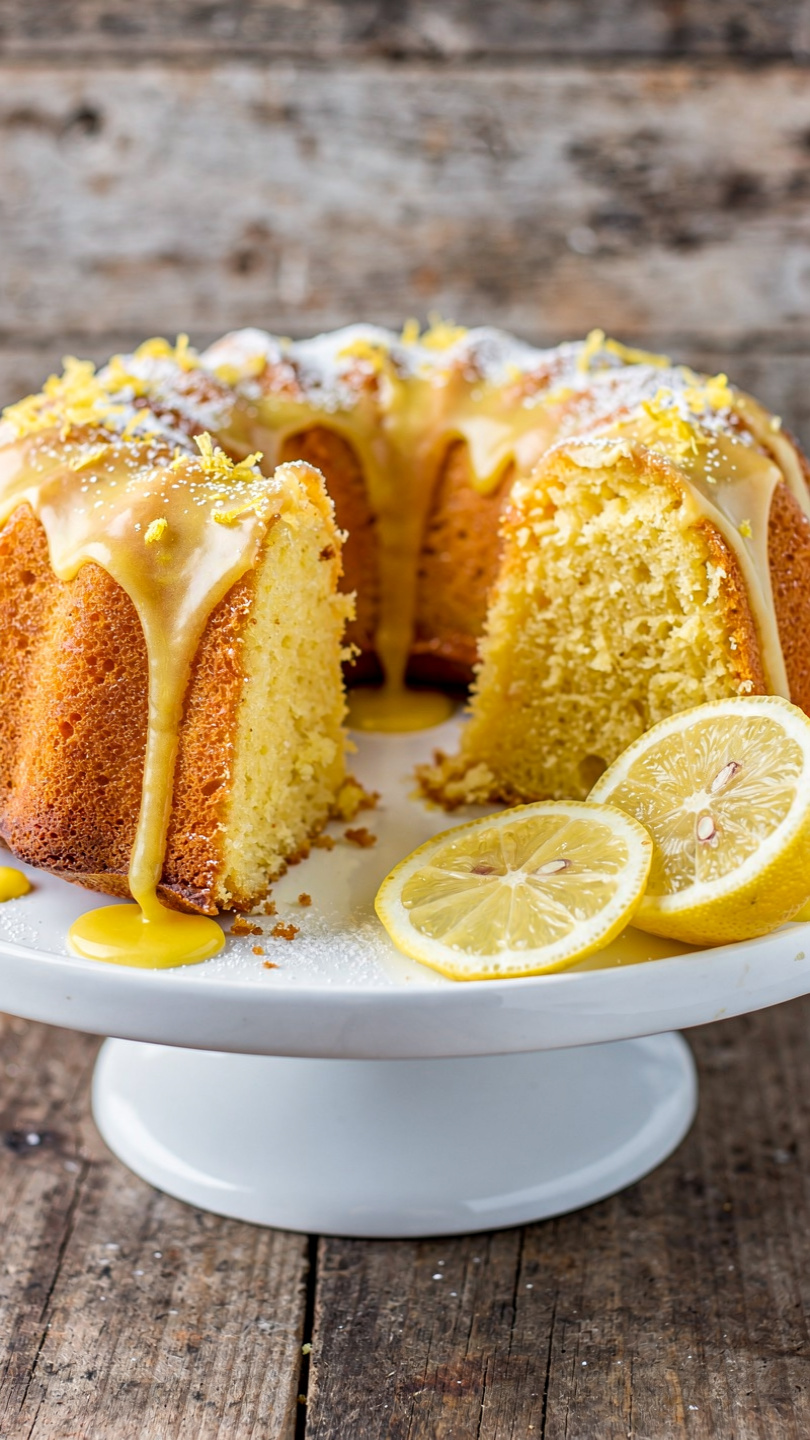
Lemon Bundt Cake
This showstopping Lemon Bundt Cake is bursting with bright citrus flavor, a tender crumb, and a glossy lemon glaze that makes every slice irresistible.

The Only Lemon Bundt Cake You Will Ever Need
There is something deeply satisfying about a Bundt cake. It arrives at the table already beautiful, requiring nothing more than a glossy drizzle of glaze to look like it came straight from a bakery window. This Lemon Bundt Cake takes that quiet elegance and fills it with bold, sunny citrus flavor that makes every single bite feel like a celebration.
Whether you are baking for a spring brunch, a birthday, a holiday table, or simply because you have a bag of lemons sitting on the counter, this cake delivers. The crumb is tender and moist thanks to full-fat sour cream, the lemon flavor is layered in with both fresh juice and zest, and that two-ingredient lemon glaze on top is the kind of finishing touch that makes people ask for your recipe before they have even finished their slice.
Using the right pan makes a real difference with Bundt cakes. A heavy, well-made Bundt pan with sharp detail releases cleanly every time, while a thin or worn pan can lead to stuck edges and a frustrating mess. The same goes for your zester: a sharp Microplane pulls fragrant zest off the lemon without biting into the bitter pith.
Tools & Ingredients We Recommend



Why Sour Cream Is the Secret Weapon
A lot of Bundt cake recipes call for milk or buttermilk, and those work just fine. But sour cream is the ingredient that takes this cake from good to genuinely great. It adds fat and moisture that keeps the crumb tender for days, and its mild tang plays beautifully against the bright lemon flavor without tasting sour at all.
If you do not have sour cream on hand, full-fat plain Greek yogurt works as a one-to-one swap and gives you a very similar result.
Chef's Tip: Make sure your butter, eggs, and sour cream are all at room temperature before you start. Cold ingredients do not cream together properly and can result in a dense, uneven crumb. Set everything out about 45 minutes before baking.
Getting the Lemon Flavor Right
The secret to a truly lemony cake is using both fresh lemon juice and lemon zest. The juice brings the tartness and brightness, while the zest carries the floral, aromatic oils that make lemon desserts smell and taste unmistakably citrusy.
Here is what to keep in mind:
- Use a Microplane or fine grater and zest the lemons before you juice them. It is much easier.
- Avoid zesting into the white pith beneath the yellow skin. The pith is bitter and can make the cake taste sharp in an unpleasant way.
- Two large lemons will give you everything you need for both the batter and the glaze.
The Most Important Step: Releasing the Cake
More Bundt cakes are ruined at the unmolding stage than at any other point. Follow these two rules and you will be fine:
- Grease and flour every crevice of your pan. Use softened butter or baking spray with flour, and get into all the grooves. Do not rush this step.
- Cool the cake for exactly 15 minutes before inverting. Too short and the cake is too fragile. Too long and steam builds up, causing the cake to stick.
Warning: Do not skip the 15-minute rest. Patience here is what gets your cake out of the pan in one perfect piece.
Ready to bake the most impressive, most delicious lemon cake you have ever made? Here is everything you need:
Lemon Bundt Cake
This showstopping Lemon Bundt Cake is bursting with bright citrus flavor, a tender crumb, and a glossy lemon glaze that makes every slice irresistible.
Ingredients
- 3 cups all-purpose flour, spooned and leveled
- 1 1/2 tsp baking powder
- 1/2 tsp baking soda
- 1/2 tsp salt
- 1 cup unsalted butter, softened to room temperature
- 1 3/4 cups granulated sugar
- 4 large eggs, room temperature
- 1 cup sour cream, full-fat, room temperature
- 1/4 cup fresh lemon juice, from about 2 large lemons
- 2 tbsp lemon zest, from about 2 large lemons, packed
- 1 tsp pure vanilla extract
- 1 1/2 cups powdered sugar, sifted, for the glaze
- 3 tbsp fresh lemon juice, for the glaze
- 1 tsp lemon zest, for garnish, optional
Instruction
Preheat your oven to 350 degrees F (175 degrees C). Generously grease and flour a 10 to 12-cup Bundt pan, making sure to coat every crevice. Set aside.
In a medium bowl, whisk together the flour, baking powder, baking soda, and salt. Set the dry ingredients aside.
In a large bowl using a hand mixer or a stand mixer fitted with the paddle attachment, beat the softened butter and granulated sugar on medium-high speed for about 4 to 5 minutes until the mixture is very pale, light, and fluffy.
Add the eggs one at a time, beating well after each addition and scraping down the sides of the bowl as needed. Mix in the vanilla extract, lemon juice, and lemon zest until fully combined.
Reduce the mixer speed to low. Add the flour mixture in three additions, alternating with the sour cream in two additions (flour, sour cream, flour, sour cream, flour). Begin and end with the flour mixture. Mix just until no dry streaks remain. Do not overmix.
Pour the batter evenly into the prepared Bundt pan and smooth the top with a spatula. Tap the pan gently on the counter a few times to release any air bubbles.
Bake for 50 to 60 minutes, or until a long wooden skewer inserted into the thickest part of the cake comes out clean and the top is golden brown.
Allow the cake to cool in the pan on a wire rack for exactly 15 minutes. Then carefully invert the cake onto the wire rack and let it cool completely, about 1 to 2 hours, before glazing.
Make the glaze: whisk together the sifted powdered sugar and fresh lemon juice in a small bowl until smooth and pourable. Adjust the consistency by adding more lemon juice (thinner) or more powdered sugar (thicker) as needed.
Once the cake is completely cool, drizzle the lemon glaze over the top, letting it drip naturally down the sides. Garnish with extra lemon zest if desired. Slice and serve.
Equipment
- 10 to 12-cup Bundt pan
- Stand mixer or hand mixer
- Large mixing bowl
- Medium mixing bowl
- Whisk
- Rubber spatula
- Wire cooling rack
- Microplane or zester
- Long wooden skewer or toothpick
Notes
Serving and Storing Your Lemon Bundt Cake
This cake is wonderful served at room temperature, which is when the glaze is at its glossiest and the crumb is at its softest. A light dusting of extra lemon zest on top just before serving makes it look stunning on any table.
For storing, keep it loosely covered at room temperature for up to 3 days. If your kitchen runs warm, the refrigerator is a better bet, where it will stay fresh for up to 5 days. Just remember to let refrigerated slices sit out for 20 to 30 minutes before eating so the butter in the crumb softens back up.
If you want to get ahead, bake the cake without the glaze and freeze it wrapped tightly in plastic for up to two months. Thaw it overnight in the fridge, bring it to room temperature, and add the fresh glaze right before serving. It will taste like you made it that morning.